Post Independence India Class 03
A BRIEF OVERVIEW OF THE PREVIOUS CLASS (05:00 PM)
SCHEMES RELATED TO TRIBALS (05:02 PM)
- Important role of TRIFED (Tribal Cooperative Marketing Development Federation of India Limited) in the Ministry of Tribal Affairs
- a) Eklavya model residential schools 1997-98- Modern education with residential facilities along with a focus on preserving tribal culture.
- b) MSP for MFP (Minimum support price for Minor forest produce)-
- b.1) MSP for minor forest produce like Tendu patta, Bamboo, Sal products like Sal leaves and seeds, wild honey, lac, tamarind, etc.
- b.2) Important because, MFP has high social and economic value for tribals as it not only provides food, medicine, and other consumption items but also cash income.
- b.3) Sustainable harvesting of MFPs and sustainable demand for MFPs is ensured by the scheme
- b.4) Under this scheme, procurement and marketing operations are conducted (* Marketing implies connecting MFP with bias- Industrial or Retail)
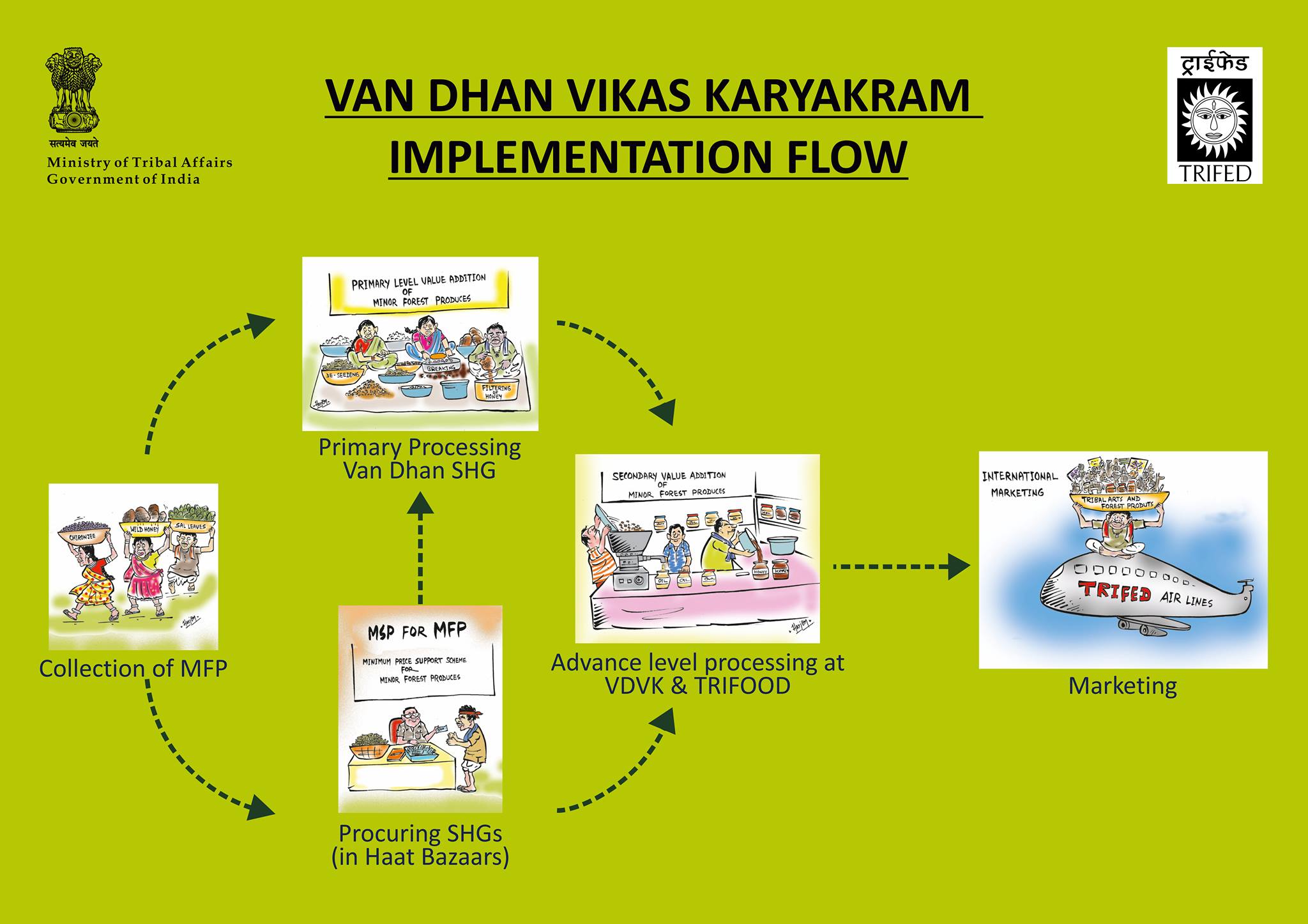
- c) PM Van Dhan Yojana- The goal is to generate livelihood by utilizing forest wealth. It promotes MSP for the MFP scheme by additionally focusing on value addition to MFP with the help of self Help Groups of tribals before the final sale.
- d) Bharat Rural Livelihood Foundation, 2013 (BRLF)-
- d.1) Its goal is to generate rural livelihood with a special focus on women and tribals
- d.2) It uses the human resource capacity of NGOs for skill development and other development projects by doing capacity building of this Human resource.
- d.3) BRLF integrates government, Private sector, and Civil society, therefore is an example of network governance
- d.4) BRLF also aims to strengthen the SHG movement and develop tribal leadership.
- d.5) Funding by private partners to BRLF is eligible for being counted as CSR contribution (Corporate social responsibility- Compulsory for companies having turnover of more than 500 crores to contribute 2% of profits towards social welfare activities)- Initial corpus was 1000 crores- 500 cr by GoI and 500 cr from other partners i.e. private companies and institutions like NABARD.
PANCHAYAT (EXTENSION TO SCHEDULED AREAS) ACT, PESA, 1996 (05:37 PM)
- Scheduled areas are governed by 5th schedule (Article 244(1))
- 5th schedule created the Tribal advisory council (TAC) which has 3/4th of members as ST MLAs, however, TAC proved ineffective as it largely has advisory functions. Therefore, PESA in 1996 gave more autonomy to local tribals and other communities by establishing PRIs.
- PESA mandates state government to devolve certain political, administrative, and financial powers to local governments/ PRIs.
- Tribals are guaranteed 50% of seats and the seat of chairperson at all levels of the panchayat system.
- However, PESA has not been fully implemented by the state government [* Federalism decreases the powers of the centre, PRIs decrease the power of state governments ]
- 1997, Samata judgment- SC ruled that the 5th schedule mandated governors to bar the purchase of tribal lands for mining activity by private players, After this GoI gave Governors unrestricted authority in the transfer of ST land to the government and then allotment to non-tribals, therefore hurting the goal of tribal autonomy.
SCHEDULED TRIBES & OTHER TRADITIONAL FOREST DWELLERS (RECOGNITION OF RIGHTS) ACT 2006 (06:00 PM)
- It is commonly known as Forest Rights Act 2006 or FRA 2006
- [* During Britishers time- Tribal autonomy hurt, Landlessness increased, Forest produce + Culture (added by SC)
- Tribal Autonomy was handled by- PESA in 1996.
- Landlessness and Forest produce rights were resolved by FRA 2006]
- It is For the 5th schedule areas
- It gives the right to land and community rights over MFP, Water bodies, and grazing areas
- It also gives responsibility to STs and OTFDs for the protection of wildlife, Forests, and biodiversity i.e. Right to manage and protect their forests. [* Use in the environment, SDG ] [** Implements 48 A]
- Maximum forest land rights that can be recognized is up to 4 hectares also rights are heritable but not transferable. [* Therefore, FRA 2006, has the consequence of preventing the transfer of land of tribal people to non-tribals ]
- Those persons are eligible who are living in and are dependent on forests for livelihood and to cultivate their land before December 2005. [* Satellite photo December 2005, cultivation, trees- FRA bans land use change after December 2005 ]
- FRA mandates the need for consent of Gram Sabha for forest land acquisition [* Therefore Gram Sabha created by PESA 1996 and now empowered by FRA, therefore, FRA strengthens PESA]
- 2013 SC judgment in Vedanta's Bauxite mining project case in Niyamgiri Hills in Odisha- here Dongria Kond tribals were protesting against the Mining of the hill they worship i.e. Niyamraja. SC recognized customary/ traditional rights of ST and OTFDs. for example- Religious rights, therefore they were given the right to protect the Hill and later Gram Sabha voted against the mining project.
- Therefore, FRA 2006 gives protection to customary rights as well after this development.
INDIA- CHINA WAR, 1962 (06:39 PM)
-

- Source- The Economist magazine
- As per the Jhonson line- Aksai chin is part of India.
- As per the McCartney-Mcdonald line- Aksai chin is part of China.
- China annexed Tibet in 1950.
- India was the first to recognize the PRC (People's Republic of China) in 1949 [* PRC= Mainland China =Chinese Communist Party led state, 1921]
- India believed that we have common past experiences of colonialism and therefore can share good relations. There were good relations until the 1950s as India and China did not share borders.
- Post-1950, when China annexed Tibet, Border disputes began over Aksai chin and NEFA.
- Also, India-USSR relations were improving while post-1953, china-USSR relations turned bad which made China anxious.
- Patel did not trust China on the issue of borders while Nehru was overtrusting.
- The entire border is disputed.
- Western sector-
- a) Jhonson Ardagh line, 1897- Jhonson was a surveyor and recommended this line in 1865. It was accepted by the British government officially in 1897 on the recommendation of Ardagh, head of military intelligence. Jhonson's line puts Aksai's chin in India.
- b) McCartney- Mcdonald line, 1899- It puts Aksai chin in China. In 1899, the British proposed this line to China via Envoy Mcdonald but no response from China, therefore this line was not finalized and the British GoI reverted back to the Jhonson Line 1897
- Eastern sector- Macmahon line 1914 (07:20 PM)
- It was the result of the Shimla Agreement of 1914 between the British and Tibet. China was invited to the conference but did not attend.
- Post-1949, CCP led government in China did not recognize the Macmahon Line 1914.
- Post-1950, Nehru sent an envoy to China to assess the view of Chinese President Zhau Enlau/Lai
- [* Chinese system- Party is supreme and not the state. State includes parliament, Judiciary, etc. A state is a tool for the party to implement communism. There is only one party i.e. Chinese communist party- one party system. Mao Zedong was the chairman of the party. The chairman of the party is the top person. President of state was given foreign policy]
- As per the response, India got the impression that China had no interest in border areas and its only interest was trade across borders.
- A satisfied Nehru went ahead and signed the 1954 treaty of friendship with China based on Panchsheel principles to guide future relations
- a) Mutual respect for each other's territorial integrity.
- b) Mutual non-aggression [* Can raise a territorial dispute without aggression e.g In United Nations]
- c) Mutual non-interference in each other's Internal affairs [* Rarely news item on India or China commenting on Xinxiang or Punjab/ Maoism in NE]
- d) Equality and Mutual benefits [* Subsidiary alliance was not based on equality because one partner was subordinate to another]
- e) Peaceful coexistence [* Xi Jinping said- "There is enough space in the world for India and China both to grow", India also promotes Vasudaiva Kutumbakam].
- However, the Mistake was that the treaty was silent on border disputes and gave no clarity on borders. Also, India accepted Tibet as part of China.
- Another mistake was that, in 1956, Dalai Lama sought asylum in India but Nehru Rejected it for good India-china relations. [* Jhataka/ Shock- 1957 report stated that China had constructed a road in Aksai Chin]
- Earlier Nehru had called Zhau Enlau and he was assured that China won't ever claim Indian territory but it was never clarified "what is Indian territory as per China".
- The road created uproar in Indian politics and Nehru wrote to China. No reply for one month and Zhau Enlau proposed that if India recognizes Aksai Chin as part of China then China will recognize Mcmahon Line 1914 i.e. NEFA with India.
- Nehru propose this in parliament and argue that Aksai Chin is a barren land to which there was high opposition. Example- Mahavir Tyagi responded that if he was bald then should the head be removed from the body, therefore with no agreement in Parliament, Nehru pulled out from negotiations.
- 1959- Dalai Lama was given asylum but political activities were not allowed.
- 1960-62- Forward policy by India and in 1962, in October china started the war.
REASONS FOR WAR (08:00 PM)
- Unsettled border dispute.
- The India-USSR relationship was improving while the China-USSR relationship deteriorated and turned sour in 1953. This made China anxious therefore china wanted to assert itself militarily as a show of strength.
- [* World history- Mao accused Nikita Krushev (1953-64) of comprising core principles of Marxism when Nikita talked about peaceful coexistence with the capitalist West and introduced some capitalistic features in USSR's economy. This created demands in China for similar reforms that irked Mao Zedong, therefore he took the Anti-USSR stand.]
- Also, china wanted to be the leader of the socialist world instead of the USSR. Further, both had long-pending border disputes since 1858 when Russia took over all territory above river Amur.
- China was facing domestic problems due to the initial failures of the "Great leap forward" (Maoism) whereby agrarian communism was promoted instead of focusing on heavy industry, a centralized industry based on mechanization and the rapid industrialization model of the USSR.
- Now focus was to be on the agrarian economy, labour-intensive industry, light industry that improves the standard of living (* Consumer durables and non-durables ), decentralized industrialization i.e. Six lakh small steel factories spread across rural areas, and gradual industrialization. This hurt GDP growth (* Agri-GDP roughly 4% whereas industrial GDP was 20% ).
- Also, due to geographical events, there were bad harvests, and therefore even the agrarian economy suffered, therefore Mao Zedong wanted to distract the Chinese Public and leaders away from domestic problems.
The Topic for the next class:- Continuation of the 1962 war.